The Amateur by Wendy Lesser
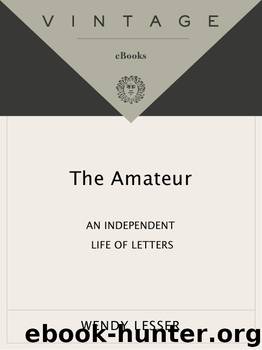
Author:Wendy Lesser [Lesser, Wendy]
Language: eng
Format: epub
ISBN: 978-0-307-87420-7
Publisher: Knopf Doubleday Publishing Group
Published: 1999-08-17T16:00:00+00:00
First published in 1854, Walden was written at a time when philanthropy still meant something very close to its Greek roots. The first examples given in the OED, from the early seventeenth century, show the word being used strictly in the sense of “love of one’s fellow man” (or, by extension, love of God to man) and the beneficent acts attached thereunto. This meaning persisted to the middle of the nineteenth century (an 1849 quote, from Wilberforce, refers piously to “the lessons of universal Philanthropy”). But by the late nineteenth century the word had taken on a less spiritual and more pecuniary meaning. “A great philanthropist has astonished the world by giving it large sums of money during his lifetime,” runs an 1875 entry in the OED; Harper’s Magazine in 1884 referred to “the head of a great hospital and many philanthropies.” This is the sense the word has for us today: it has moved away from a personal and occasionally religious form of giving to a more purely financial one.
If one wanted to speak about giving money during the seventeenth, eighteenth, or early nineteenth century, one used instead the word alms—or, occasionally, charity. Alms derives from eleemosynary, a word which got its most famous outing (I would venture to say that many people know it only from this context) in the first sentence of Fielding’s Tom Jones: “An author ought to consider himself, not as a gentleman who gives a private or eleemosynary treat, but rather as one who keeps a public ordinary, at which all persons are welcome for their money.” The novelist’s mistrust of philanthropy had thus begun by 1749, a good century before Dickens. And the ambivalent feelings attached to charitable giving did not appear only in fiction. Samuel Johnson, in his 1773 Dictionary, defined alms straightforwardly enough as “What is given gratuitously in relief of the poor.” But he went on to illustrate the word by offering the sentence, “The poor beggar hath a just demand of alms from the rich man; who is guilty of fraud, injustice, and oppression, if he does not afford relief according to his abilities”—which kind of takes the gratuitousness out of “gratuitously.” Dr. Johnson also remarked, with his typically digressive sense of the truly interesting, that the word alms “has no singular.” One cannot give an alm, only alms—again the subliminal sense of obligation and extension (one quarter is not enough …).
In fact, all the words associated with philanthropic giving seem afflicted with comparable grammatical eccentricities. Philanthropy itself has no verb form (to philanthropize? to philanthrape?), despite the fact that it currently denotes an action. Perhaps that omission came about partly through its origins as a purely spiritual or attitudinal virtue: Johnson defines it as “love of mankind; good nature,” both of which can be possessed without necessarily being demonstrated. Benefactor (to which Johnson gives the secondary definition “he that contributes to some public charity”) also has no verb form, only another noun—benevolence—to represent the action rather than the actor.
Download
This site does not store any files on its server. We only index and link to content provided by other sites. Please contact the content providers to delete copyright contents if any and email us, we'll remove relevant links or contents immediately.
Hit Refresh by Satya Nadella(9140)
When Breath Becomes Air by Paul Kalanithi(8449)
The Girl Without a Voice by Casey Watson(7890)
A Court of Wings and Ruin by Sarah J. Maas(7852)
Do No Harm Stories of Life, Death and Brain Surgery by Henry Marsh(6944)
Shoe Dog by Phil Knight(5271)
The Rules Do Not Apply by Ariel Levy(4971)
A Higher Loyalty: Truth, Lies, and Leadership by James Comey(4965)
Hunger by Roxane Gay(4929)
Tuesdays with Morrie by Mitch Albom(4787)
Everything Happens for a Reason by Kate Bowler(4745)
The Immortal Life of Henrietta Lacks by Rebecca Skloot(4591)
Millionaire: The Philanderer, Gambler, and Duelist Who Invented Modern Finance by Janet Gleeson(4481)
How to Change Your Mind by Michael Pollan(4358)
All Creatures Great and Small by James Herriot(4326)
The Money Culture by Michael Lewis(4211)
Man and His Symbols by Carl Gustav Jung(4138)
Elon Musk by Ashlee Vance(4129)
Tokyo Vice: An American Reporter on the Police Beat in Japan by Jake Adelstein(3997)
